
Turn YouTube Video Analytics Into Topic Wins
If you’re a content strategist, you already know the cost of guessing. One wrong “new topic” can waste weeks of production and delay growth.
With My Videos, you can analyze your channel’s patterns faster and plan what to post next with confidence.
What you’ll unlock in your analytics
Clicks (CTR)
Turn impressions into action signals.
Retention & watch time
See what keeps viewers engaged.
Understand how YouTube finds your videos.
Subscribers & growth momentum
Track growth signals beyond views.
Identify what drives performance influenced by the YouTube algorithm—and plan what to post next with confidence.
Why “Stop Guessing” Works: The YouTube Algorithm Already Told You
YouTube doesn’t reward “good ideas.” It rewards videos that earn attention and keep it.
Your video history is essentially a set of experiments the algorithm already ran for your channel:
Which topics your audience actually wants
Which titles/thumbnails earn clicks
Which formats retain viewers
Which keywords match real search and suggested demand
Which content gaps you can fill next
When you good ideas aren’t enough, your analytics become the playbook.
The Content Strategist’s YouTube Analytics Map (What to Look At)
Before planning topics, you need to read your analytics like a strategist—not like a viewer. Here are the core signals that usually predict performance outcomes:
1) Impressions → Clicks (CTR)
Track which videos earned traffic and how efficiently they convert impressions into clicks.
Strategist takeaway: High CTR often points to strong topic + title + thumbnail alignment. Low CTR often means your packaging doesn’t match viewer intent.
2) Retention → Watch Time
Retention shows whether the audience stays after clicking. Focus on average view duration, audience retention curves, and key drop-off moments (especially in the first minute).
Strategist takeaway: Retention reveals whether your hook, pacing, and structure match what viewers expect from the promise you made.
3) Traffic Sources (How YouTube Found It)
You’ll typically see a mix of Browse features, Suggested videos, Search, and External (if relevant).
Strategist takeaway: A video that wins on Search behaves differently than one that wins on Suggested. Your next topic plan should reflect that.
4) Engagement & Growth Signals
Look at likes / comments patterns (directional), subscriber conversion (direct value), and returning viewers and overall watch session impact (context-dependent).
Strategist takeaway: Some videos drive views without converting. Others convert because they match audience identity—not just curiosity.
Turn Analytics Into Decisions: The “What to Post Next” Framework
Here’s a repeatable strategy workflow that converts analytics into topic selection (and not just reporting):
Step 1: Classify Every Video by Intent
Create simple buckets like:
- Search-intent (“how to…”, “best…”, “X vs Y”)
- Browse-intent (lists, story, react, entertainment angles)
- Problem/solution formats
- Beginner vs advanced
Step 2: Identify Winning Patterns (Not One-Off Hits)
Find recurring traits across your best-performing videos:
- Similar topic angles
- Similar pacing/structure
- Similar thumbnail style
- Similar “promise” in the title
- Similar length and segmenting
Strategist takeaway: Repeat patterns that show up across multiple videos—not just a single viral anomaly.
Step 3: Build Topic Clusters From Your Actual Demand
Instead of brainstorming randomly, build clusters like:
- Core topic
- Sub-topic variations
- Common questions
- Adjacent “next step” problems
Then map each cluster to your observed performance signals:
- Which clusters get Search traffic?
- Which clusters get suggested momentum?
- Which formats retain best?
Step 4: Use Keyword Reality (Your Channel’s Evidence)
Your keywords shouldn’t be guessed—they should be supported by what your channel already earns.
Output: a ranked list of topics + title angles + keyword targets that match what YouTube is already recommending or searching for on your channel.
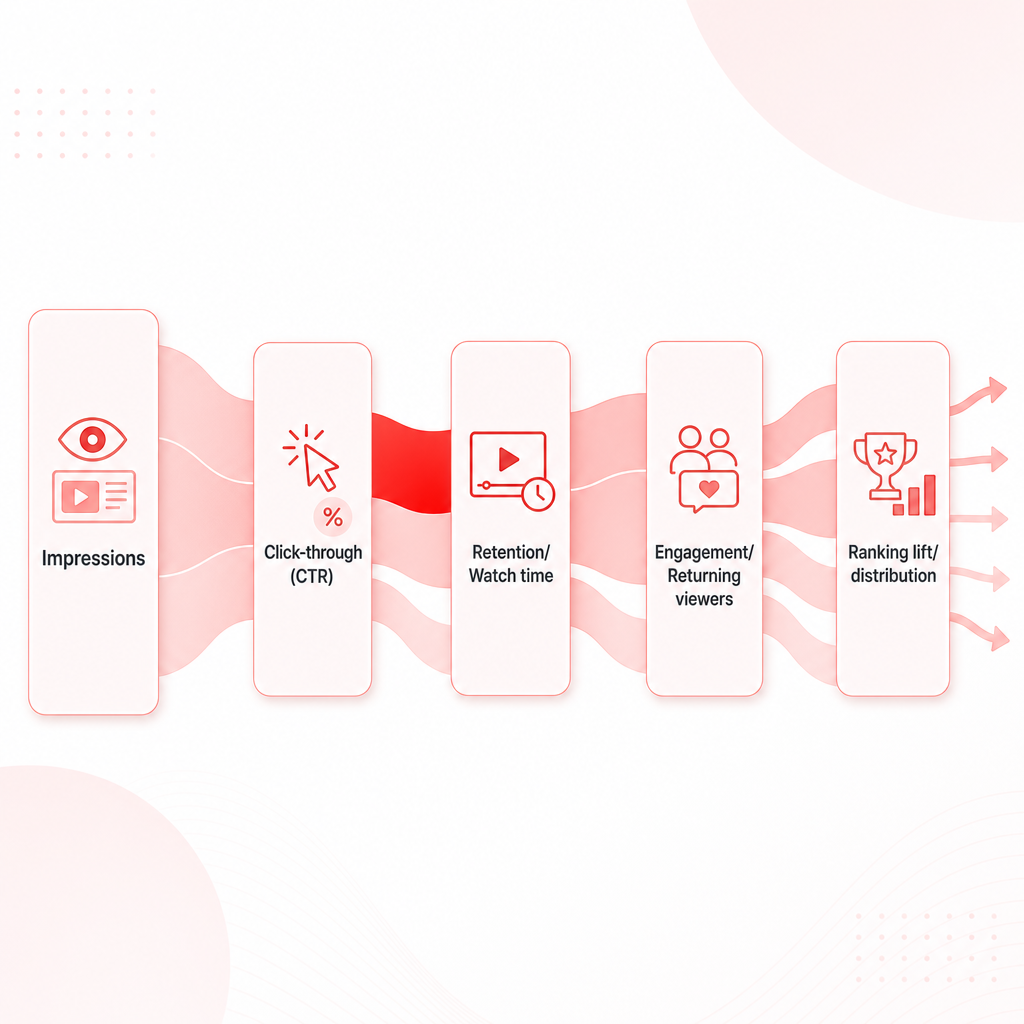
Where a Sankey Diagram Fits: Visualize Your Path to Views
To make pattern-finding easier, strategists often use a Sankey Diagram to connect steps in the viewer journey.
Example Sankey flow for YouTube performance
Impressions (Browse/Search/Suggested) → Click-through (CTR) → Retention / Watch time → Engagement + returning viewers → Ranking lift / distribution (via the YouTube algorithm)
In practice, a Sankey Diagram helps answer questions like:
- Which traffic source produces the highest click efficiency?
- Which source produces the best retention (not just clicks)?
- Where does performance break—packaging, promise, or content delivery?
Strategist takeaway: Instead of asking “Why did this video perform?”, you can ask “Where exactly did the funnel strengthen or fail?”
Use this logic to improve the next upload: change the promise (title/thumbnail) if CTR is the bottleneck; change structure/first minute if retention is the bottleneck.
GapTube.ai “My Videos”: Your Personal YouTube Performance Research Tool
With My Videos — Learn What Actually Works, GapTube.ai helps you stop guessing by analyzing your own performance and uncovering:
- Which topics earn views
- Which titles/thumbnails drive clicks
- Which formats and structures retain viewers
- Which keywords correlate with distribution
- What to double down on next
- content gap opportunities
It’s powered by real-time trend scanning worldwide and is designed to streamline research into actionable planning.
Built for content strategy (not just dashboards)
Instead of drowning in charts, GapTube.ai helps you turn analytics into:
- a repeatable content decision system
- a prioritized “post next” roadmap
- keyword-backed topic ideas based on your channel’s evidence
Plus, it supports planning in over 70 languages—useful for creators targeting global audiences.
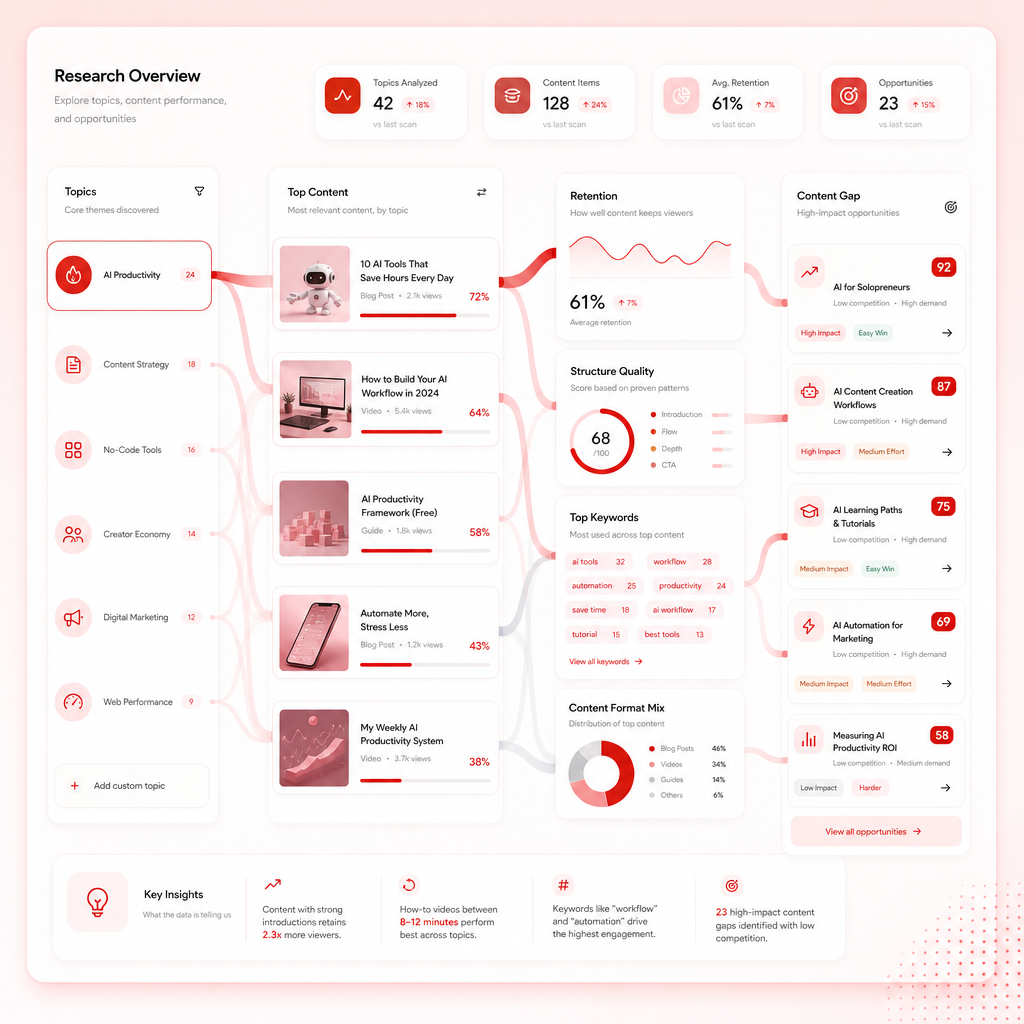
Turn your analytics into actionable planning—start with My Videos.
Benchmarking: How to Check Other Channels (Without Copying)
Sometimes you need context: Are you aiming at demand that exists in your niche?
You can use analytics approaches from established tools and workflows to benchmark competitors, such as:
Benchmark what already works
- checking upload patterns and formats
- comparing topic themes that appear consistently in high-performing videos
- reviewing engagement and traffic behaviors
- studying what kinds of titles/thumbnails win clicks in similar niches
Why GapTube.ai is different
- you learn what your audience already responds to
- you reduce risk when testing new angles
- you improve decisions around what to scale vs what to retire
YouTube Rankings: What Really Changes When You Improve Strategy
A common trap: focusing only on “views” metrics.
Higher YouTube rankings usually come from a chain of improvements:
- better packaging (CTR)
- stronger satisfaction signals (retention, watch time)
- better relevance (keywords + topic alignment)
- better distribution fit (traffic source behavior)
Your past video performance becomes a roadmap:
- Which improvements should you standardize?
- Which formats are “yours” (not just trending)?
- Which topics convert viewers into channel growth?
That’s what “My Videos” is built for.
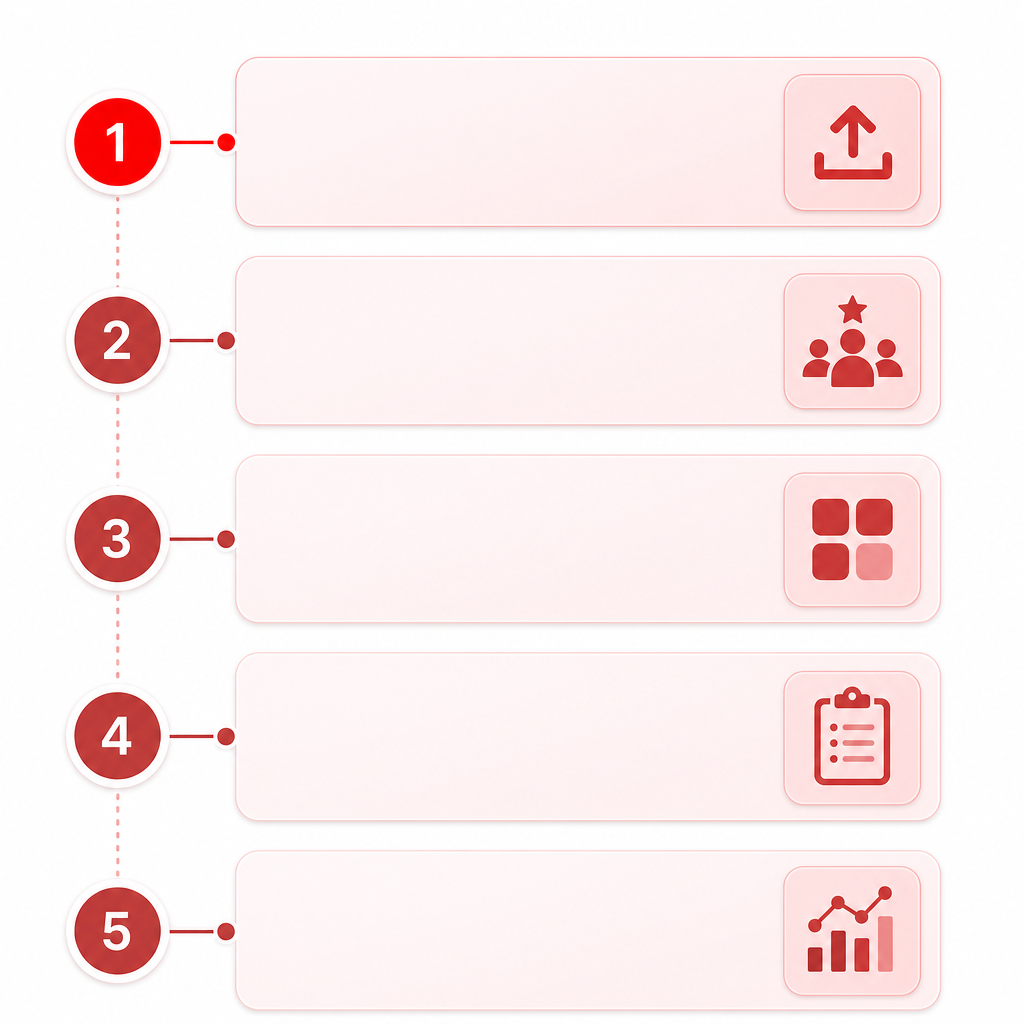
The Practical Strategy Plan (Use This This Week)
If you want a fast, conversion-focused workflow, do this:
- Audit last 20–50 uploads
- Identify your top performers by: views + CTR efficiency, retention strength, distribution behavior (search vs suggested)
- Group them into topic clusters and format patterns
- Build a “next 10 uploads” backlog: double down on proven angles; test 1–2 adjacent topic variations; refine titles/thumbnails based on observed packaging signals
- Publish and compare performance—then update your patterns
GapTube.ai speeds up this loop by turning your analytics into strategy outputs you can act on quickly.
Common Mistakes Content Strategists Make (Avoid These)
- Chasing one viral video instead of repeating measurable patterns
- Ignoring CTR vs retention tradeoffs (a video can click but not satisfy)
- Planning topics without intent (search-style won’t perform like browse-style)
- Over-optimizing titles only when retention is the real bottleneck
- Not benchmarking traffic sources (suggested winners require different hooks than search winners)
Instead: repeat what’s working, map each bottleneck to the funnel step, and update your patterns after you publish.
Frequently Asked Questions
? Does “My Videos” replace YouTube Studio analytics?
No—GapTube.ai helps you interpret and turn those analytics into content decisions faster, with strategy-focused outputs.
? What’s the best metric to start with: CTR or retention?
Start with both. If you’re low on views, check CTR efficiency first; if views come but drop off, retention is the bottleneck.
? How does a Sankey Diagram help YouTube strategy?
It visualizes your performance funnel across steps (traffic → clicks → retention → outcomes), making it easier to pinpoint what needs changing.
? Can I use this for both new channels and growing channels?
Yes. The approach works when you have enough data (or even early data for directional patterns). GapTube.ai is designed to support both starting and scaling.
? Will this help me understand the YouTube algorithm better?
It helps you translate algorithm signals into actions: what packaging, structure, keywords, and topic intent are already working for your channel.
Ready to Stop Guessing and Start Producing Winning Topics?
Get deeper insight from your own channel performance and turn analytics into a practical roadmap for better topic selection, smarter iteration, and improved YouTube rankings.
Start with your channel today and learn what actually works.
Use your past performance to guide the next upload with confidence.