
YouTube Channel Management Playbook & Idea System
If you manage a YouTube channel—internally or for clients—your job isn’t just posting videos. It’s deciding what to publish next, validating what will perform, and building a repeatable content system.
This pillar page is a practical YouTube analytics guide + YouTube trends workflow built for YouTube Channel Managers who need:
- Actionable competitor gap discovery
- A repeatable way to generate daily video ideas
- Clear metrics to guide decisions (not guesses)
And yes—GapTube.ai ties it all together by helping you find trending YouTube content gaps and turn them into video opportunities faster.
Discover trending topics in your niche
Find untapped video ideas competitors are missing
Plan videos with daily insights
Stop guessing what to post—make your next upload a decision backed by metrics, trends, and gaps.
This Guide Is for YouTube Channel Managers
You’re responsible for growing and planning channels, so you typically juggle:
- Content calendars and production capacity
- Keyword research + trend monitoring
- Competitor research and positioning
- Performance review and optimization
- Team alignment (scripts, titles, thumbnails, publishing)
If you’ve ever thought, “We’re posting… but we don’t know what to post next”, this is your system.
1) YouTube Channel Management Duties (What to Manage—Every Week)
Think of YouTube Channel Management as a closed loop:
A. Strategy & Channel Positioning
- Define your niche boundaries (and your “adjacent” expansion zones)
- Set content pillars (what your channel is known for)
- Choose formats that match viewer intent (tutorials, comparisons, reviews, how-to, news-style, etc.)
Manager takeaway: Strategy isn’t a slide deck—it’s a decision filter for every new topic.
B. Content Planning (The Real Bottleneck)
Your calendar should be built from:
- YouTube trends (what’s gaining attention now)
- Search-driven topics (what people are looking for)
- Competitor gap discovery (what your competitors aren’t covering well—or at all)
C. Publishing & Optimization
Every upload needs:
- Title + thumbnail strategy aligned with viewer intent
- Strong first 30–60 seconds pacing
- On-video structure that supports retention
D. Performance Review (Analytics, Not Feelings)
- What drove views (impressions, CTR)
- What held attention (retention, AVD)
- What converted viewers into subscribers (subscriber conversion)
E. Iteration & Experiments
A management system includes experiments:
- Testing new title angles
- Revisiting winning topics in new subtopics
- Improving formats that underperform
F. Community & Brand Maintenance
- Comments + feedback loops (topic mining)
- Community posts and retention loops
- Audience-driven idea generation
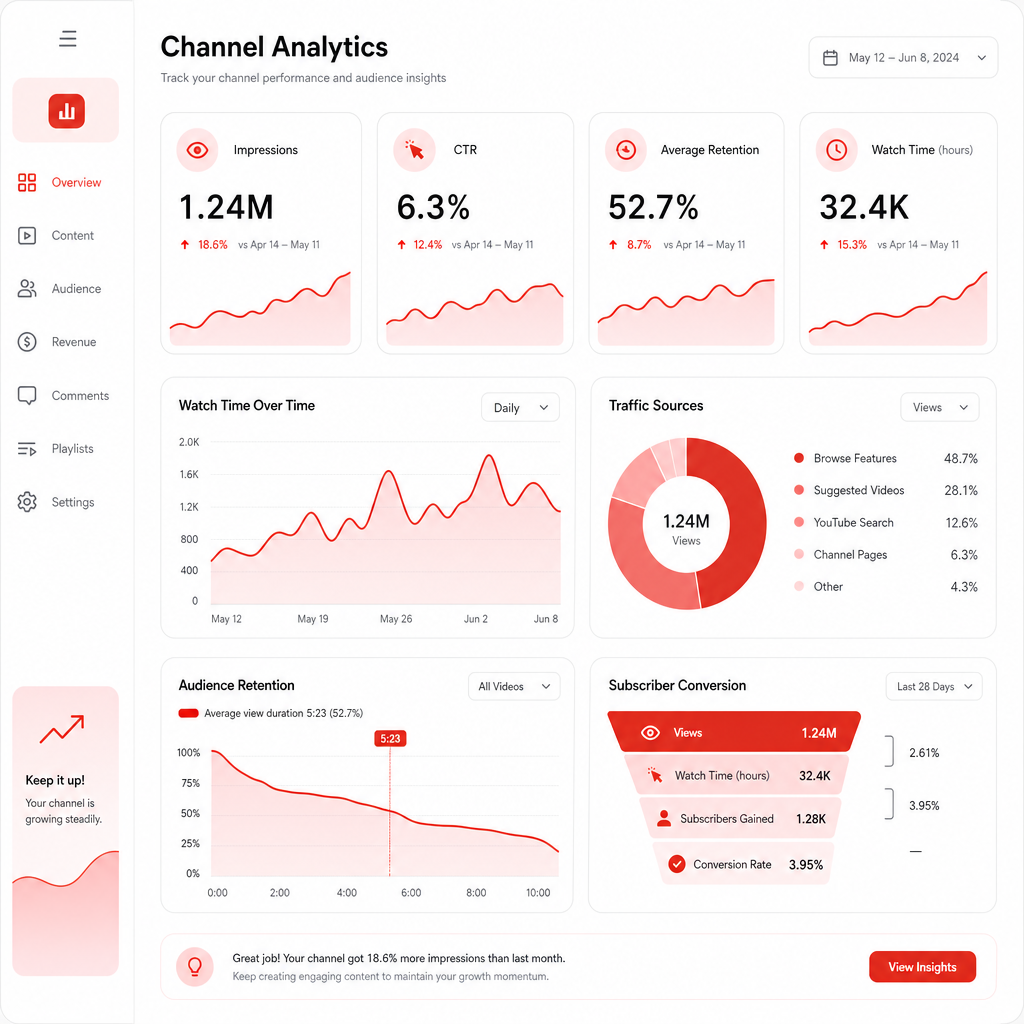
2) YouTube Analytics Guide (Key Metrics You Must Actually Use)
A “YouTube analytics guide” isn’t a list of metrics—it’s knowing what to do when numbers move.
The Core Metrics That Decide Your Next Upload
1) Impressions & CTR (Thumbnails + Titles)
- Impressions = how often YouTube shows your video
- CTR (Click-Through Rate) = how compelling your packaging is
If CTR is low: you need better title/thumbnail angle—not a whole new niche.
2) Audience Retention & Average View Duration (Content Quality + Hook)
- High retention early often means your hook and pacing are working
- If retention drops quickly, your intro may not match viewer expectation
If retention is low: revisit structure, pacing, and expectation-setting.
3) Watch Time (Impact on recommendations)
Total watch time helps YouTube decide what to recommend to whom. Aim for content that keeps viewers watching, not just clicking.
4) Traffic Sources (Where views come from)
Use this to understand: are you winning through browse features or search? Are you being discovered by related videos?
Manager action: If search dominates, keyword/topic alignment matters more. If browse dominates, packaging + topic breadth matters more.
5) Subscriber Conversion (Are you building a channel?)
Look at the rate of subscribers gained relative to views.
If subscriber conversion is weak: your content may be attracting the wrong audience or not delivering consistent value.
A Simple Weekly Review Template (30 minutes)
- Top 3 videos this week: What metric drove views?
- Bottom 3 videos: What metric failed (CTR, retention, watch time)?
- Update your next content plan based on the failure point: CTR issue → test new packaging; retention issue → restructure hook + sections; watch time issue → improve pacing + depth; conversion issue → tighten your promise to the audience
3) YouTube Trends: How to Spot What’s Actually Worth Making
YouTube trends can be noisy. The goal is to detect trend opportunities with a “channel fit”—not viral luck.
Trend Signals That Matter for Managers
- Rising search intent (people are actively looking)
- Topic clusters (multiple related queries and formats gaining momentum)
- Recent competitor acceleration (they’re doubling down on something)
- Content type shifts (new angles, formats, or updated “best of” content)
- Seasonality windows (predictable spikes by month/quarter)
How to Turn “Trends” into a Content Plan
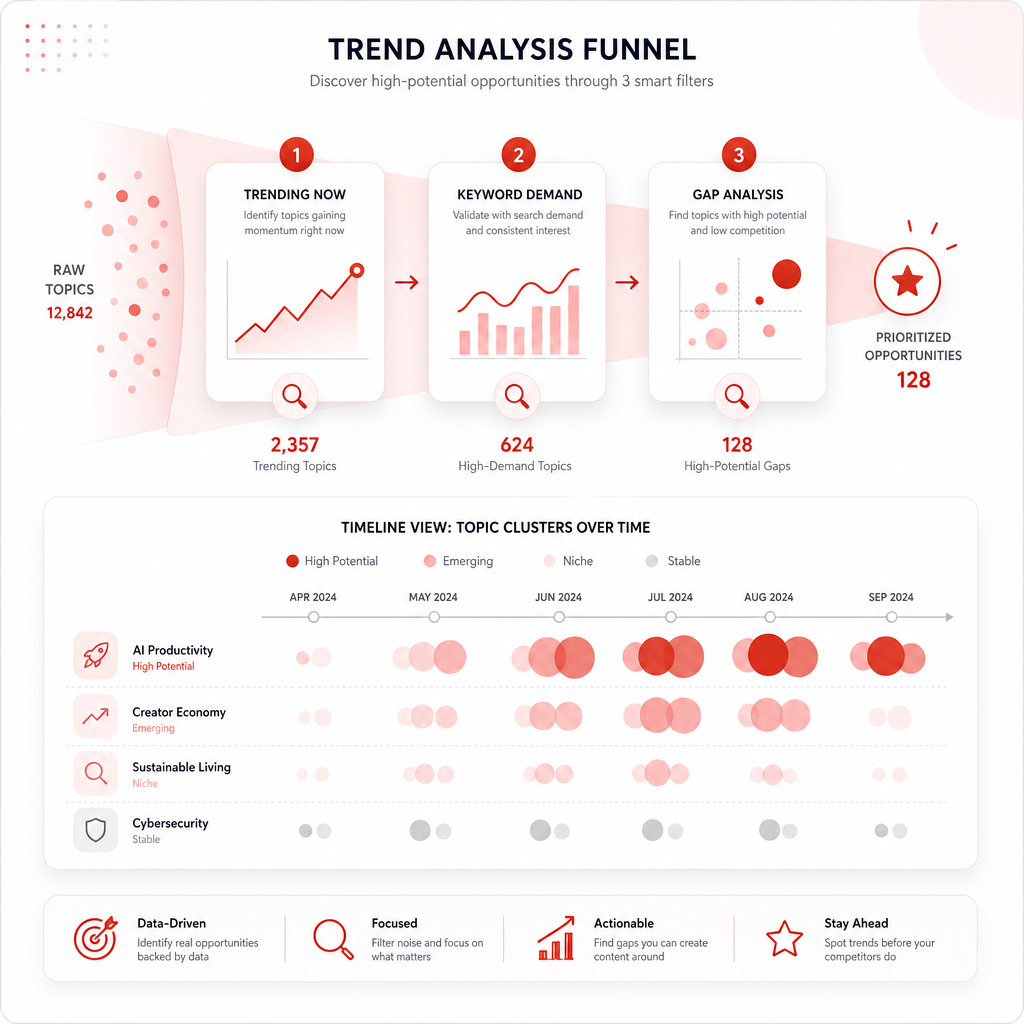
Use a 3-part filter:
- Is it trending now? (YouTube trends signal)
- Is there keyword demand? (searchable topics)
- Is there a gap? (competitor coverage is missing, weak, or too broad)
GapTube.ai automates this filter by scanning real-time trends and surfacing gaps you can act on.
4) Competitor Gap Discovery (How to Find Untapped Video Ideas)
Competitor research shouldn’t end at “what they posted.” For gap discovery, you’re looking for what’s missing.
The Competitor Gap Discovery Framework
Step 1: Pick true competitors (not just big channels)
Choose channels:
- In your niche
- Similar audience
- Similar content format style
Step 2: Map their content coverage
For each competitor, list:
- Top-performing topics
- Recent video themes
- Repeated subtopics
Step 3: Identify the gaps
Common gaps include:
- Subtopic omission (they cover the broad topic, not the specific “how”)
- Keyword mismatch (they target big terms but ignore high-intent searches)
- Poor coverage (topics exist, but quality/structure is weak)
- Format gap (they don’t cover the topic in a format your audience wants)
- Fresh angle gap (no “update,” “vs,” “mistakes,” “beginner path,” etc.)
Step 4: Score opportunities
Pick ideas that score high on:
- Search intent
- Packaging friendliness
- Fit with your channel pillars
- Competition strength (is it underserved?)
Manager takeaway: Your content plan should include both: Proven audience demand (search + intent) and Differentiated coverage (gaps + angles)

5) Daily Video Idea Generation System (Never Run Out Again)
The best YouTube Channel Management systems don’t rely on inspiration. They rely on repeatable daily inputs.
The “Daily Ideas” Workflow (Manager-Ready)
Step 1: Daily trend scan (10 minutes)
- Identify rising topics and emerging keywords in your niche
- Capture 10–20 candidate ideas
Step 2: Gap filter (10 minutes)
- Remove topics your competitors already own
- Keep topics where coverage is missing, weak, or outdated
Step 3: Keyword-to-video mapping (10 minutes)
- For each idea: Choose one primary keyword topic
- Add 3–7 supporting keywords
- Define viewer intent (learn, compare, solve, decide)
Step 4: Packaging angle (5 minutes per idea)
- Write 2–3 title directions: “How to…” “X mistakes…” “Best/Top…” “X vs Y” “Beginner path…” “Updated in 2026…” (when relevant)
Step 5: Pick for the calendar (your capacity decides)
- If you can publish daily: pick 1–2 ideas per day
- If you can publish weekly: pick 3–5 ideas for the week and schedule
What to track for the system to improve
- Which idea types get better CTR
- Which idea types get higher retention
- Which idea types increase subscriber conversion
Over time, your daily ideas become smarter because your analytics feedback loop is built-in.
6) How GapTube.ai Helps You Manage YouTube Faster (and Smarter)
GapTube.ai is an AI-powered YouTube research tool designed for YouTube creators and YouTube Channel Managers who want to stop guessing.
Instead of spending hours on:
- manual trend hunting
- competitor scraping
- keyword research
- “is this worth it?” decision-making
GapTube.ai helps you
- Discover trending topics in your niche
- Find untapped video ideas competitors are missing
- Research YouTube content faster
- Get keyword and topic suggestions in 70+ languages
- Plan videos with daily insights
- Grow your channel with data-backed content ideas
Built for the exact pain point
“I don’t know what video to make next.”
GapTube.ai answers it by scanning real-time trends worldwide, identifying content gaps, and turning them into actionable video opportunities.
7) Use Cases by Channel Stage
If you’re managing a growing channel
- Prioritize topics that fit your pillars but cover missing angles
- Build a consistent upload system with daily idea inputs
If you’re scaling a channel (or managing multiple)
- Find more opportunities without increasing manual research time
- Expand into adjacent topics with keyword and gap discovery
- Use data-backed ideas to standardize the content planning process
If you’re managing clients
- Provide clearer direction: “Here’s the trend + keyword intent + gap reason”
- Reduce churn from last-minute topic changes
- Create repeatable deliverables for planning and ideation
8) 7-Day Implementation Plan (Put This Into Action Fast)
- Day 1: Audit last 10 videos using the weekly review template
- Day 2: Choose 5 competitor channels and map their topic coverage
- Day 3: Create your content pillars and define your “gap standards”
- Day 4: Run a daily idea scan (collect 10–20 candidates)
- Day 5: Filter candidates using gaps + keyword intent
- Day 6: Build packaging angles for the top 5 ideas
- Day 7: Publish one idea and set up your next week’s plan based on early performance
If you want to run this faster, GapTube.ai is designed to automate the research and gap discovery steps so you can spend more time planning and producing.
9) Ready to Never Run Out of YouTube Video Ideas?
Stop guessing what to post.
GapTube.ai finds trending YouTube opportunities in your niche so you can create videos people are already searching for—using content gaps, keywords, and daily insights.
Includes Hundreds of keywords for that topic, forever yours.
Frequently Asked Questions
What is YouTube channel management?
YouTube channel management is the ongoing process of planning, publishing, optimizing, and analyzing content to grow and monetize a channel—based on data, not guesswork.
How do I use a YouTube analytics guide for better video ideas?
Track which metrics drive success (CTR for packaging, retention for content quality, watch time for recommendations). Then generate new ideas that specifically improve the weakest metric from past videos.
What are YouTube trends and how do I find the right ones?
YouTube trends are topics gaining attention. The “right” trends match your niche and show demand signals (search intent) and/or content gaps you can cover better.
How do I discover content gaps in my niche?
Compare your niche competitors’ topic coverage, then look for missing subtopics, weak coverage, outdated angles, or format gaps—then map gaps to keyword intent.
Is GapTube.ai useful for channel managers, not just creators?
Yes. GapTube.ai speeds up trend monitoring, competitor gap discovery, and daily idea generation—helping managers plan faster, justify topic choices with evidence, and keep calendars full.
Want daily, data-backed video ideas without hours of research?
GapTube.ai is designed to help you find trending YouTube opportunities in your niche.
Plan faster with trends, analytics, and a daily idea system.